Agentic AI · Healthcare · internal
MedicAI
Multi-tenant multi-agent clinical AI platform.
LangGraph-orchestrated clinical platform with specialized agents, Agentic RAG, tenant isolation, human-in-the-loop gates, and evaluation via LangSmith and RAGAS.
Problem
Clinical workflows require specialized reasoning, retrieval, and strict controls—single…
System
A stateful multi-agent system with structured routing, tool execution, retrieval, valid…
Role
AI Architecture & Agent Orchestration
Status
internal
Outcome
Multi-agent LangGraph orchestration
My role
AI Architecture & Agent Orchestration
- AI Architecture
- Agent Orchestration
- Retrieval
- Evaluation
- Productionization
Period / 2025
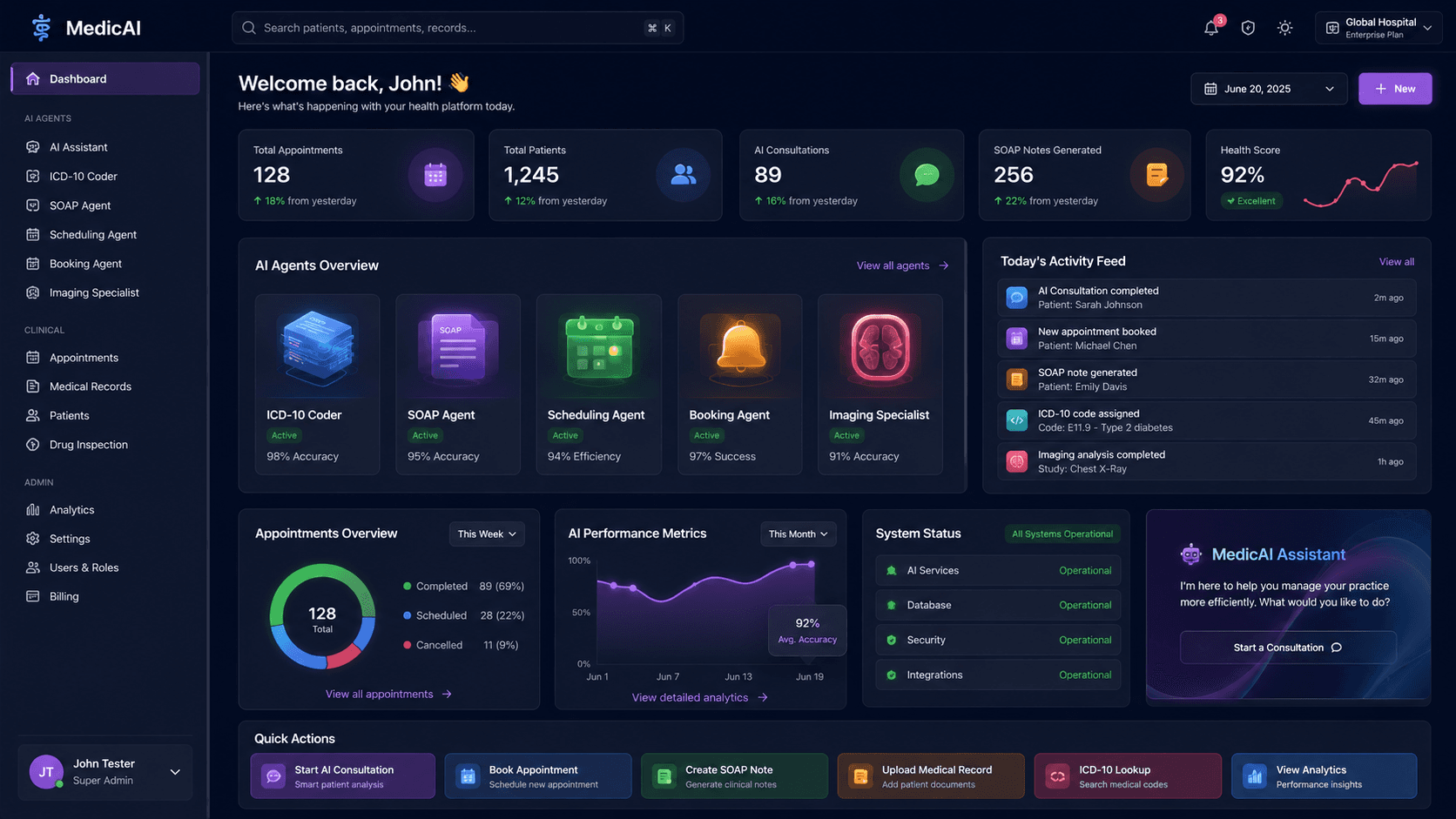
Clinical agents & hospital operations interface
Plays once · tap to replay
Problem
Clinical workflows require specialized reasoning, retrieval, and strict controls—single-prompt chatbots cannot safely handle coding, documentation, triage, and imaging in a multi-tenant environment.
System
A stateful multi-agent system with structured routing, tool execution, retrieval, validation, and human approval where required—observed and evaluated in production-minded workflows.
Architecture
Authenticated tenant context enters a LangGraph router that dispatches specialized clinical agents with RAG, tools, memory, and workflow paths—then validation, optional HITL, and observability.
- Request → Auth / Tenant
- Auth / Tenant → LangGraph Router
- LangGraph Router → Specialized Agents
- Specialized Agents → Agentic RAG
- Specialized Agents → Tools
- Specialized Agents → Memory
- Specialized Agents → Clinical Workflow
- Agentic RAG → Validation / Guardrails
Execution path plays once on view · hover a node or tap the canvas to replay
System anatomy
Architecture
LangGraph orchestration with structured routing across specialists.
- State graph
- Router
- Specialized agents
- Tool execution
Engineering decisions
Decision
Explicit LangGraph state orchestration
Constraint
Clinical tasks need structured routing across specialists with inspectable transitions.
Approach
A state graph makes agent transitions, tool calls, and approval gates inspectable and controllable.
Result
Controllable multi-agent clinical workflows with explicit route selection.
Decision
Human-in-the-loop gating
Constraint
High-risk clinical outputs require approval boundaries before release.
Approach
HITL gates prevent automatic release of sensitive recommendations without review.
Result
Approval gates on sensitive clinical recommendations.
Decision
Tenant isolation with RBAC
Constraint
Multi-tenant clinical data cannot share context casually.
Approach
Isolation and role controls are first-class architecture constraints, not afterthoughts.
Result
Tenant isolation and role-based access as core platform constraints.
Decision
LangSmith + RAGAS evaluation loop
Constraint
Agent quality must be measured as orchestration changes.
Approach
Tracing and retrieval evaluation close the loop between orchestration changes and measurable behavior.
Result
Observable agent behavior with retrieval evaluation feedback.
Reliability
- Tenant isolation / RBACACTIVE
- Schema validationACTIVE
- GuardrailsACTIVE
- Human-in-the-loop gatesACTIVE
- Structured routingACTIVE
Evaluation
Outcome / Results
- Specialized agents for ICD-10, SOAP docs, scheduling, imaging, triage, and clinical Q&A.
- Production controls: tenant isolation, Redis/PostgreSQL state, guardrails, schema validation.
- Observability and retrieval evaluation with LangSmith and RAGAS.
Stack
Product visuals